The Ingress NGINX Migration Just Got Easier: 119 Annotations, 3 Targets, Impact Ratings
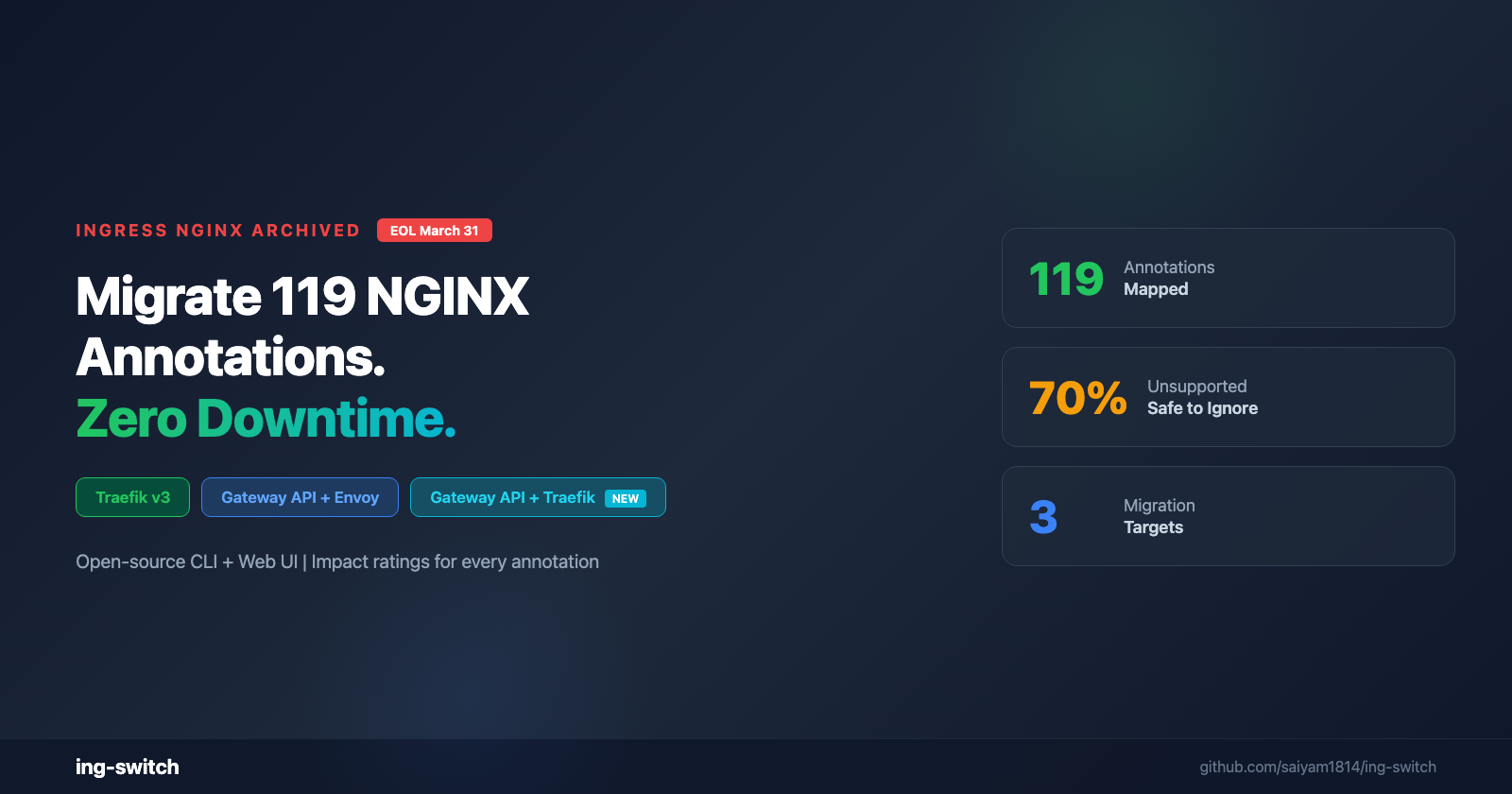
"Ingress NGINX was archived March 24, 2026. ing-switch maps all 119 NGINX annotations with

On this page (18)
- Why You Need to Migrate Now
- The Three Migration Paths
- The Annotation Problem
- End-to-End Demo: vCluster + ing-switch
- Step 1: Create a Cluster
- Step 2: Install Ingress NGINX
- Step 3: Deploy 3 Apps with NGINX Annotations
- Step 4: Scan the Cluster
- Step 5: Analyze Compatibility
- Step 6: Generate Migration Files
- Step 7: Inspect the Generated YAML
- Step 8: Review the Migration Report
- Step 9: Apply (Dry-Run First)
- Step 10: Verify and Cutover
- Step 11: Use the Web UI
- Cleanup
- What Makes ing-switch Different
- The Ecosystem Is Ready
A few months ago, I built ing-switch and wrote about it on kubesimplify. The response was incredible -- people loved the annotation mapping and the visual dashboard.
Since then, ingress-nginx was officially archived (March 24, 2026). March 31 is end of life -- zero security patches after that date.
Based on community feedback from KubeCon, this is the biggest update yet: 119 annotations (up from 50), Gateway API with Traefik as the provider (the #1 request), and impact ratings on every annotation so you know exactly what matters.
This post walks through a complete end-to-end migration on a vind cluster with actual command outputs.
Why You Need to Migrate Now #
-
Nov 11, 2025: Kubernetes SIG Network announces ingress-nginx retirement
-
Jan 29, 2026: Joint statement from Kubernetes Steering + Security Response Committees urging immediate migration
-
Mar 24, 2026: GitHub repository archived (read-only)
-
Mar 31, 2026: End of life -- zero support from this date
Chainguard maintains a fork for CVE-level fixes only -- no features, no community PRs, no pre-built images. You're on your own.
The Three Migration Paths #
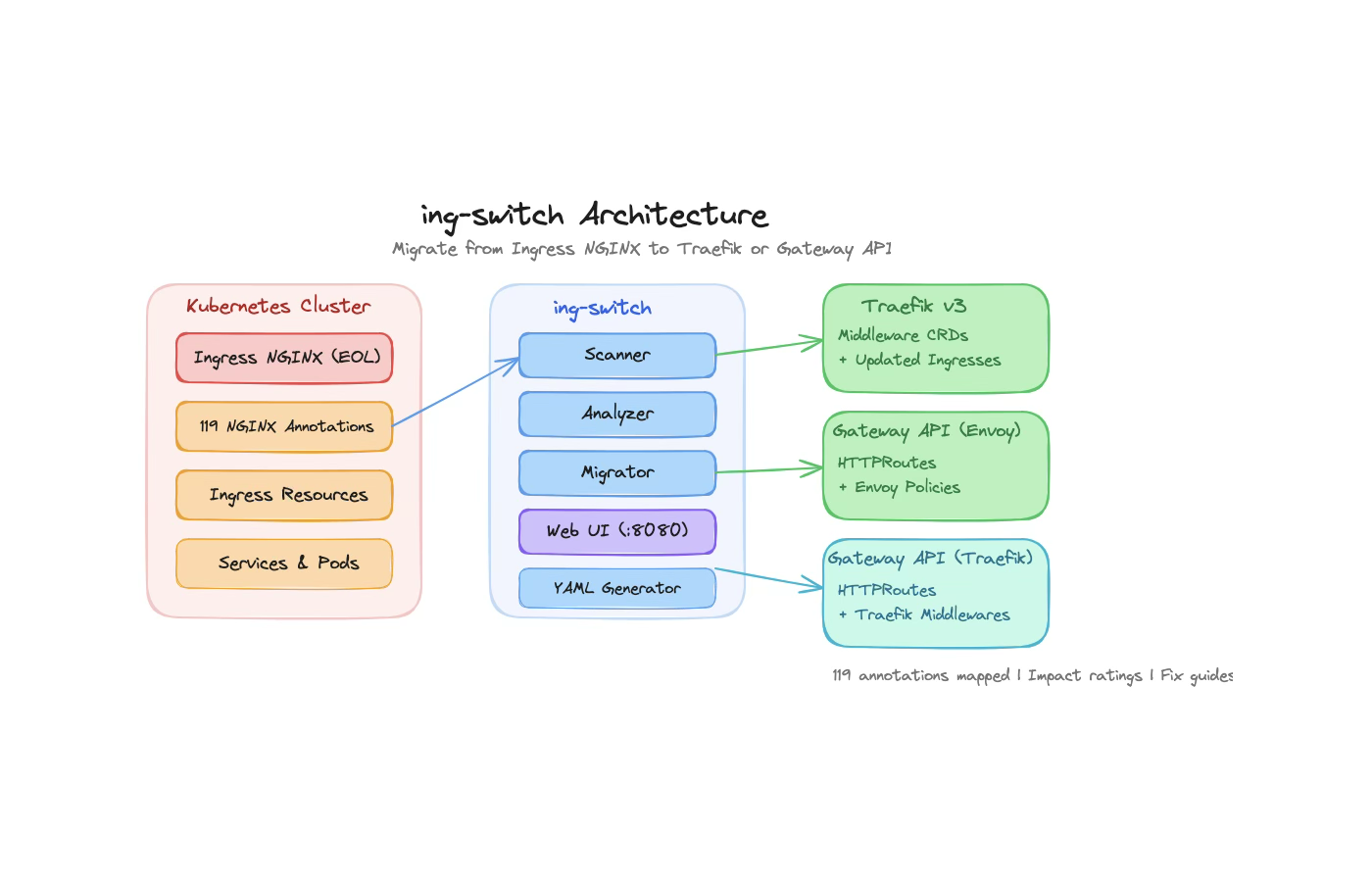
| Target | Best For | What Changes |
|---|---|---|
| Traefik v3 | Fastest migration, lowest friction | Keep Ingress API, swap annotations to Middleware CRDs |
| Gateway API (Envoy) | Future-proof standard | Replace Ingresses with HTTPRoutes, Envoy policies |
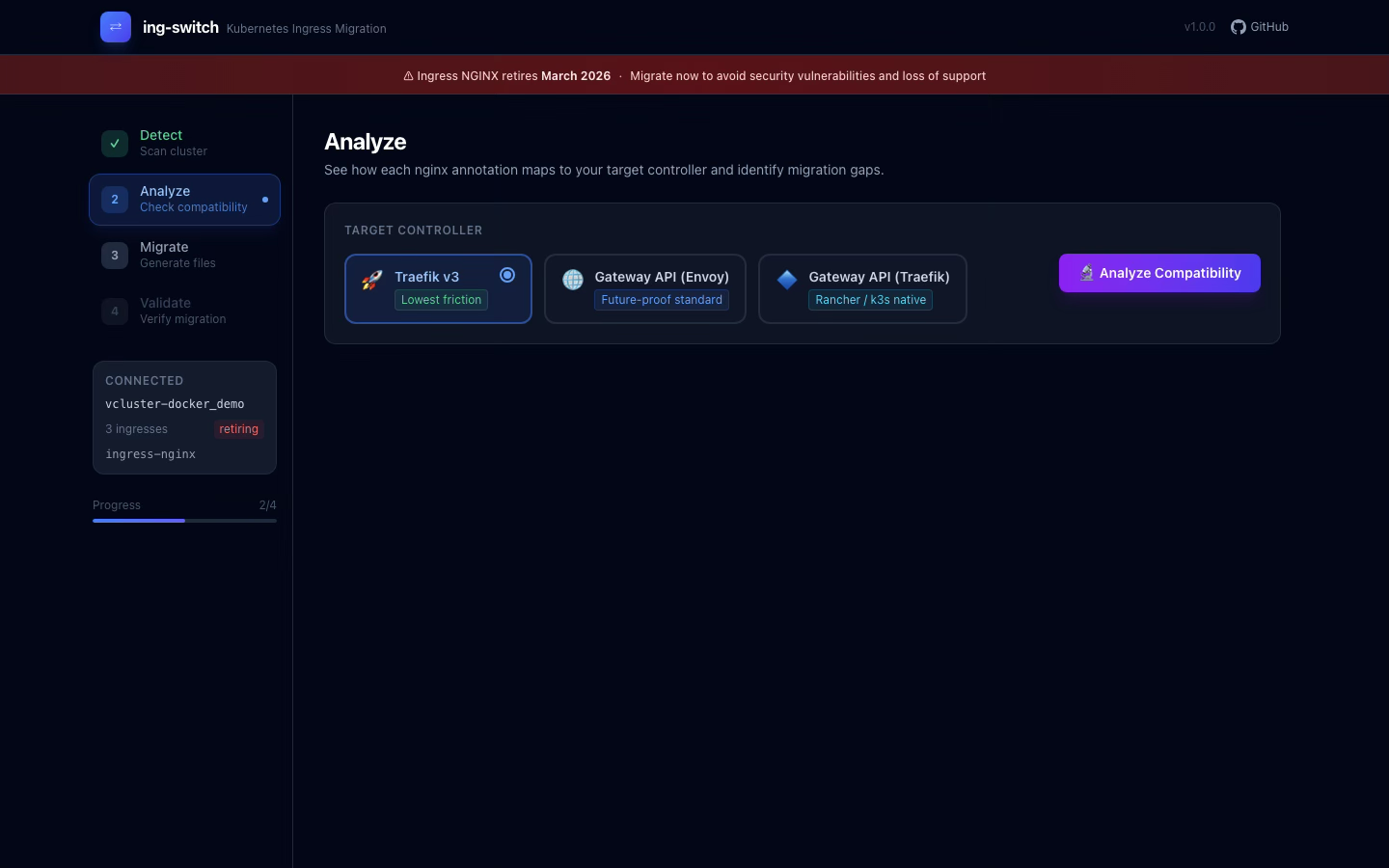
| Gateway API (Traefik) | Rancher / k3s users | Standard HTTPRoutes + Gateway resources, with Traefik as the controller implementation. Advanced features (rate limiting, auth, IP filtering) use Traefik Middleware CRDs as extension policies. |
The Annotation Problem #
The real complexity isn't swapping controllers -- it's the annotations. A typical production Ingress has 10-15 NGINX annotations for SSL, auth, rate limiting, CORS, session affinity, and more.
ing-switch maps 119 annotations with impact ratings:
| Traefik | Gateway API | |
|---|---|---|
| Supported (direct equivalent) | 35 | 39 |
| Partial (needs minor adjustment) | 48 | 25 |
| Unsupported (with impact notes) | 42 | 62 |
Every unsupported annotation gets an impact rating: NONE (safe to ignore), LOW (better defaults), MEDIUM (needs workaround), or VARIES (review your snippets). Most teams discover 70%+ of "unsupported" annotations are safe to ignore.
End-to-End Demo: vCluster + ing-switch #
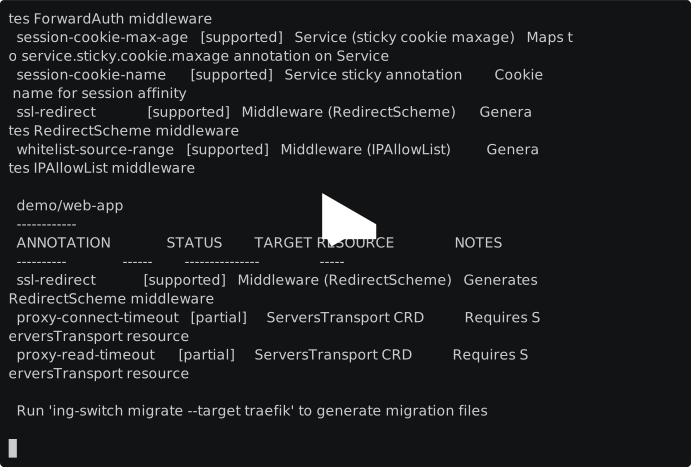
Let's walk through a complete migration on a real cluster. We'll use vCluster to spin up a Kubernetes cluster in Docker, deploy 3 services with NGINX annotations, and migrate them to Gateway API with Traefik.
Step 1: Create a Cluster #
vcluster create demo --driver dockerOutput:
info  Using vCluster driver 'docker' to create your virtual clusters
info  Ensuring environment for vCluster demo...
done  Created network vcluster.demo
info  Starting vCluster standalone demo
done  Successfully created virtual cluster demo
info  Waiting for vCluster to become ready...
done  vCluster is ready
done Switched active kube context to vcluster-docker_demoVerify:
kubectl get namespacesNAME STATUS AGE
default Active 16s
kube-flannel Active 6s
kube-node-lease Active 16s
kube-public Active 16s
kube-system Active 16s
local-path-storage Active 6sStep 2: Install Ingress NGINX #
helm repo add ingress-nginx https://kubernetes.github.io/ingress-nginx
helm install ingress-nginx ingress-nginx/ingress-nginx \
  --namespace ingress-nginx \
  --create-namespace \
  --set controller.service.type=ClusterIP \
  --set controller.admissionWebhooks.enabled=false \
--wait --timeout 120sNAME: ingress-nginx
LAST DEPLOYED: Sun Mar 29 11:15:57 2026
NAMESPACE: ingress-nginx
STATUS: deployedkubectl get pods -n ingress-nginxNAME READY STATUS RESTARTS AGE
ingress-nginx-controller-5486dbd97f-vc9wv 1/1 Running 0 54sStep 3: Deploy 3 Apps with NGINX Annotations #
We deploy three services, each with different annotation patterns:
App 1 -- Basic web app (SSL redirect + timeouts):
apiVersion: networking.k8s.io/v1
kind: Ingress
metadata:
  name: web-app
  namespace: demo
  annotations:
    nginx.ingress.kubernetes.io/ssl-redirect: "true"
    nginx.ingress.kubernetes.io/proxy-read-timeout: "60"
    nginx.ingress.kubernetes.io/proxy-connect-timeout: "10"
spec:
  ingressClassName: nginx
  rules:
  - host: web.example.com
    http:
      paths:
      - path: /
        pathType: Prefix
        backend:
          service:
            name: web-app
            port:
number: 80App 2 -- API with CORS + rate limiting (10 annotations):
apiVersion: networking.k8s.io/v1
kind: Ingress
metadata:
  name: api-cors
  namespace: demo
  annotations:
    nginx.ingress.kubernetes.io/force-ssl-redirect: "true"
    nginx.ingress.kubernetes.io/enable-cors: "true"
    nginx.ingress.kubernetes.io/cors-allow-origin: "https://app.example.com,https://admin.example.com"
    nginx.ingress.kubernetes.io/cors-allow-methods: "GET, POST, PUT, DELETE, OPTIONS"
    nginx.ingress.kubernetes.io/cors-allow-headers: "Content-Type, Authorization, X-API-Key"
    nginx.ingress.kubernetes.io/cors-allow-credentials: "true"
    nginx.ingress.kubernetes.io/cors-max-age: "86400"
    nginx.ingress.kubernetes.io/limit-rps: "50"
    nginx.ingress.kubernetes.io/limit-burst-multiplier: "3"
    nginx.ingress.kubernetes.io/proxy-body-size: "5m"
spec:
  ingressClassName: nginx
  rules:
  - host: api.example.com
    http:
      paths:
      - path: /v1
        pathType: Prefix
        backend:
          service:
            name: api-service
            port:
number: 80App 3 -- Auth-protected dashboard (external auth + IP allowlist + session affinity):
apiVersion: networking.k8s.io/v1
kind: Ingress
metadata:
  name: dashboard
  namespace: demo
  annotations:
    nginx.ingress.kubernetes.io/ssl-redirect: "true"
    nginx.ingress.kubernetes.io/auth-url: "https://auth.example.com/verify"
    nginx.ingress.kubernetes.io/auth-response-headers: "X-User-ID,X-User-Email"
    nginx.ingress.kubernetes.io/whitelist-source-range: "10.0.0.0/8,172.16.0.0/12"
    nginx.ingress.kubernetes.io/affinity: "cookie"
    nginx.ingress.kubernetes.io/session-cookie-name: "dashboard-session"
    nginx.ingress.kubernetes.io/session-cookie-max-age: "3600"
spec:
  ingressClassName: nginx
  rules:
  - host: dashboard.example.com
    http:
      paths:
      - path: /
        pathType: Prefix
        backend:
          service:
            name: dashboard
            port:
number: 80After applying all three:
kubectl get ingress -n demoNAME CLASS HOSTS ADDRESS PORTS AGE
api-cors nginx api.example.com 80 5s
dashboard nginx dashboard.example.com 80 5s
web-app nginx web.example.com 80 5skubectl get pods -n demoNAME READY STATUS RESTARTS AGE
api-service-5f99b6d99d-x7vmn 1/1 Running 0 24s
dashboard-9ddbf867-7dbgf 1/1 Running 0 24s
web-app-969c76b7c-7wqw5 1/1 Running 0 24s3 ingresses, 20 NGINX annotations, 3 services running. Now let's see what ing-switch makes of this.
Step 4: Scan the Cluster #
ing-switch scan ing-switch -- Cluster Scan Results
Cluster: vcluster-docker_demo
Ingress Controller Detected
Type: ingress-nginx
Version: unknown
Namespace: ingress-nginx
Found 3 Ingress resource(s)
NAMESPACE NAME HOSTS ANNOTATIONS TLS COMPLEXITY
--------- ---- ----- ----------- --- ----------
demo api-cors api.example.com 10 no unsupported
demo dashboard dashboard.example.com 7 no complex
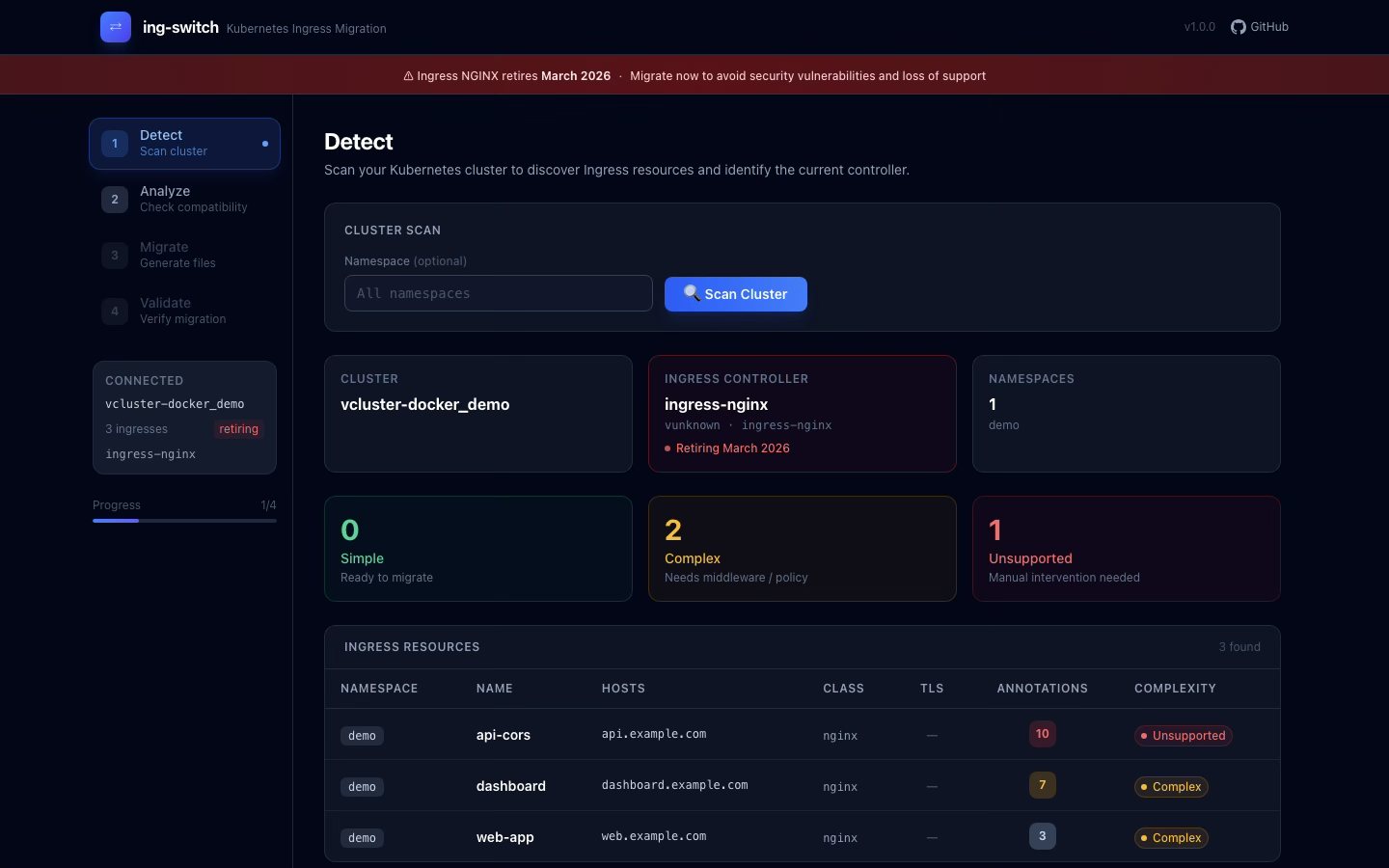
demo web-app web.example.com 3 no complexing-switch detected the NGINX controller and found all 3 ingresses with their annotation counts and complexity scores.
Step 5: Analyze Compatibility #
Let's compare all three targets:
Traefik v3:
ing-switch analyze --target traefik Summary
-------
Total ingresses: 3
Fully compatible: 1
Needs workarounds: 2
Has unsupported: 0Gateway API (Envoy):
ing-switch analyze --target gateway-api Summary
-------
Total ingresses: 3
Fully compatible: 0
Needs workarounds: 3
Has unsupported: 0Gateway API (Traefik):
ing-switch analyze --target gateway-api-traefik Summary
-------
Total ingresses: 3
Fully compatible: 0
Needs workarounds: 3
Has unsupported: 0Key insight: Traefik is the highest-compatibility target for this workload (1 fully compatible out of 3). The CORS annotations map directly to Traefik's Headers middleware. For Gateway API, CORS is now also fully supported thanks to the native CORS filter in Gateway API v1.5.
Here's the detailed annotation mapping for the API with CORS:
  demo/api-cors
  -------------
  ANNOTATION               STATUS        TARGET RESOURCE                    NOTES
  enable-cors              [supported]   HTTPRoute (CORS filter)            Native CORS filter (GA in Gateway API v1.5)
  cors-allow-origin        [supported]   HTTPRoute (CORS filter)            allowOrigins in CORS filter
  cors-allow-methods       [supported]   HTTPRoute (CORS filter)            allowMethods in CORS filter
  cors-allow-headers       [supported]   HTTPRoute (CORS filter)            allowHeaders in CORS filter
  cors-allow-credentials   [supported]   HTTPRoute (CORS filter)            allowCredentials in CORS filter
  cors-max-age             [supported]   HTTPRoute (CORS filter)            maxAge in CORS filter
  force-ssl-redirect       [supported]   HTTPRoute (RequestRedirect filter) 301 redirect to HTTPS
  limit-rps                [partial]     BackendTrafficPolicy (RateLimit)   Envoy Gateway BackendTrafficPolicy
  limit-burst-multiplier   [partial]     BackendTrafficPolicy (RateLimit)   Burst configurable but uses tokens
proxy-body-size [partial] BackendTrafficPolicy requestBuffer.limit7 out of 10 annotations are fully supported. The 3 "partial" ones work -- they just use a slightly different API.
Step 6: Generate Migration Files #
ing-switch migrate --target gateway-api-traefik --output-dir ./migration ing-switch -- Generating Migration Files
Target: gateway-api-traefik
Output dir: ./migration
+ 00-migration-report.md
+ 01-install-gateway-api-crds/install.sh
+ 02-install-traefik-gateway/helm-install.sh
+ 02-install-traefik-gateway/values.yaml
+ 03-gateway/gatewayclass.yaml
+ 03-gateway/gateway.yaml
+ 04-httproutes/demo-api-cors.yaml
+ 04-httproutes/demo-dashboard.yaml
+ 04-httproutes/demo-web-app.yaml
+ 05-policies/demo-api-cors-ratelimit.yaml
+ 05-policies/demo-dashboard-forwardauth.yaml
+ 05-policies/demo-dashboard-ipallowlist.yaml
+ 06-verify.sh
+ 07-cleanup/remove-nginx.sh
Generated 13 files in ./migration/Step 7: Inspect the Generated YAML #
GatewayClass -- points to Traefik, not Envoy:
apiVersion: gateway.networking.k8s.io/v1
kind: GatewayClass
metadata:
  name: traefik
spec:
controllerName: traefik.io/gateway-controllerHTTPRoute with native CORS filter (no more ResponseHeaderModifier hacks):
apiVersion: gateway.networking.k8s.io/v1
kind: HTTPRoute
metadata:
  name: api-cors
  namespace: demo
spec:
  parentRefs:
  - name: ing-switch-gateway
    namespace: default
  hostnames:
  - "api.example.com"
  rules:
  - matches:
    - path:
        type: PathPrefix
        value: "/v1"
    filters:
    - type: CORS
      cors:
        allowOrigins:
        - type: Exact
          value: "https://app.example.com"
        - type: Exact
          value: "https://admin.example.com"
        allowMethods:
        - "GET"
        - "POST"
        - "PUT"
        - "DELETE"
        - "OPTIONS"
        allowHeaders:
        - "Content-Type"
        - "Authorization"
        - "X-API-Key"
        allowCredentials: true
        maxAge: "86400s"
    backendRefs:
    - name: api-service
port: 80Traefik Middleware CRDs (not Envoy-specific policies):
# Rate Limiting
apiVersion: traefik.io/v1alpha1
kind: Middleware
metadata:
  name: demo-api-cors-ratelimit
  namespace: demo
spec:
  rateLimit:
    average: 50
burst: 3# ForwardAuth (external authentication)
apiVersion: traefik.io/v1alpha1
kind: Middleware
metadata:
name: demo-dashboard-forwardauth
namespace: demo
spec:
forwardAuth:
address: "https://auth.example.com/verify"
authResponseHeaders:
- "X-User-ID"
- "X-User-Email"# IP AllowList
apiVersion: traefik.io/v1alpha1
kind: Middleware
metadata:
name: demo-dashboard-ipallowlist
namespace: demo
spec:
ipAllowList:
sourceRange:
- "10.0.0.0/8"
- "172.16.0.0/12"Step 8: Review the Migration Report #
The migrate command automatically generates 00-migration-report.md in the output directory. Open it to see the full summary:
cat ./migration/00-migration-report.md# ing-switch Migration Report
**Target Controller:** gateway-api-traefik
## Summary
| Metric | Count |
|--------|-------|
| Total Ingresses | 3 |
| Fully Compatible | 0 |
| Needs Workarounds | 3 |
| Has Unsupported Annotations | 0 |
## demo/api-cors -- Needs workaround
| Annotation | Status | Target Resource | Notes |
|-----------|--------|-----------------|-------|
| enable-cors | OK | HTTPRoute (CORS filter) | Native CORS filter (GA in v1.5) |
| cors-allow-origin | OK | HTTPRoute (CORS filter) | allowOrigins in CORS filter |
| limit-rps | WARN | BackendTrafficPolicy | Envoy Gateway BackendTrafficPolicy |
...Step 9: Apply (Dry-Run First) #
# Install Gateway API CRDs
bash ./migration/01-install-gateway-api-crds/install.sh

# Install Traefik with Gateway API provider
bash ./migration/02-install-traefik-gateway/helm-install.sh

# Dry-run all resources first
kubectl apply -f ./migration/03-gateway/ --dry-run=server
kubectl apply -f ./migration/04-httproutes/ --dry-run=server

# If dry-run passes, apply for real
kubectl apply -f ./migration/03-gateway/
kubectl apply -f ./migration/04-httproutes/
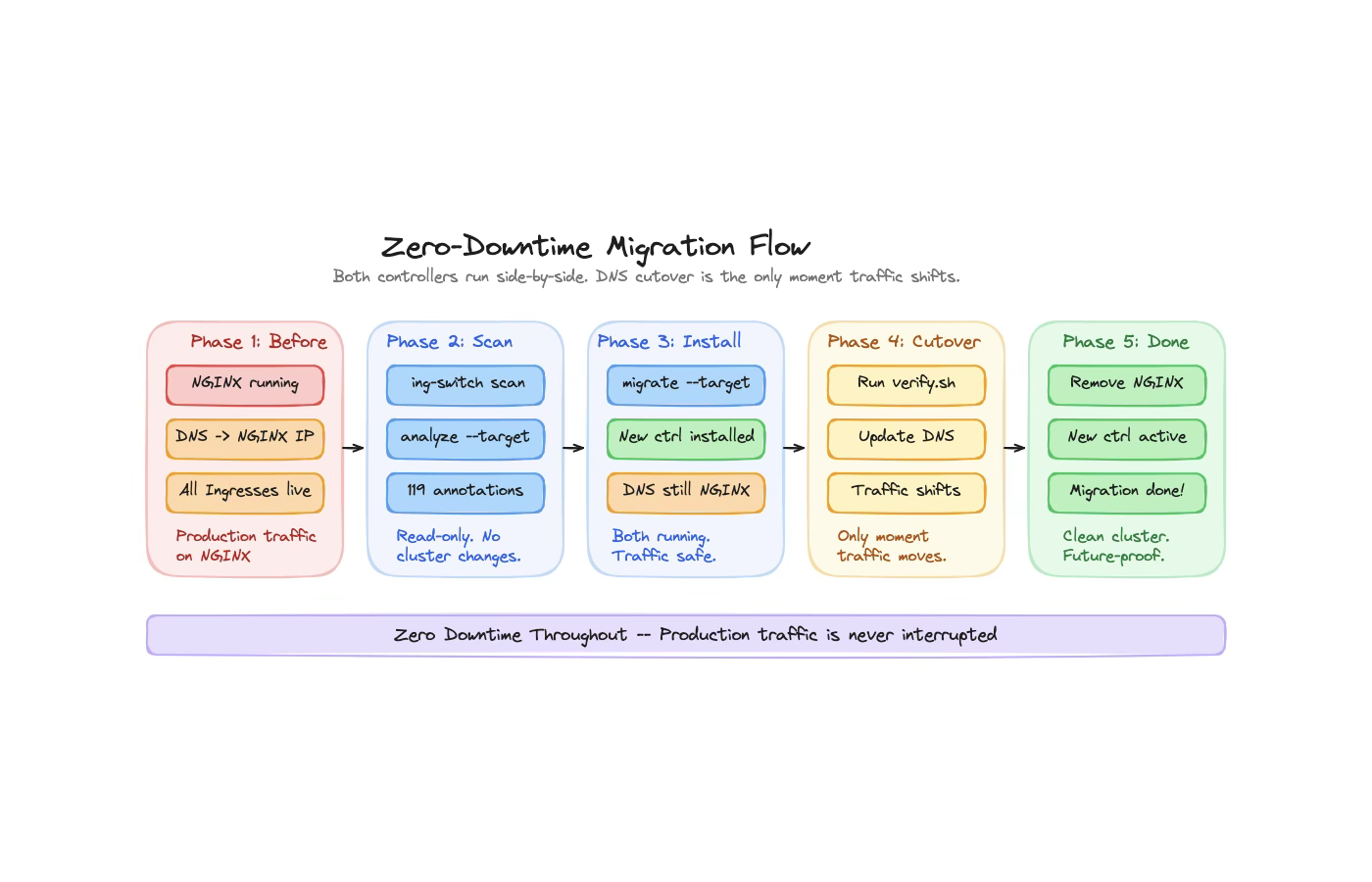
kubectl apply -f ./migration/05-policies/At this point, both NGINX and Traefik are running side by side. DNS still points to NGINX. Production traffic is untouched.
Step 10: Verify and Cutover #
# Run the generated verification script
bash ./migration/06-verify.sh

# Once verified, update DNS to Traefik's IP
# Then clean up NGINX
bash ./migration/07-cleanup/remove-nginx.shStep 11: Use the Web UI #
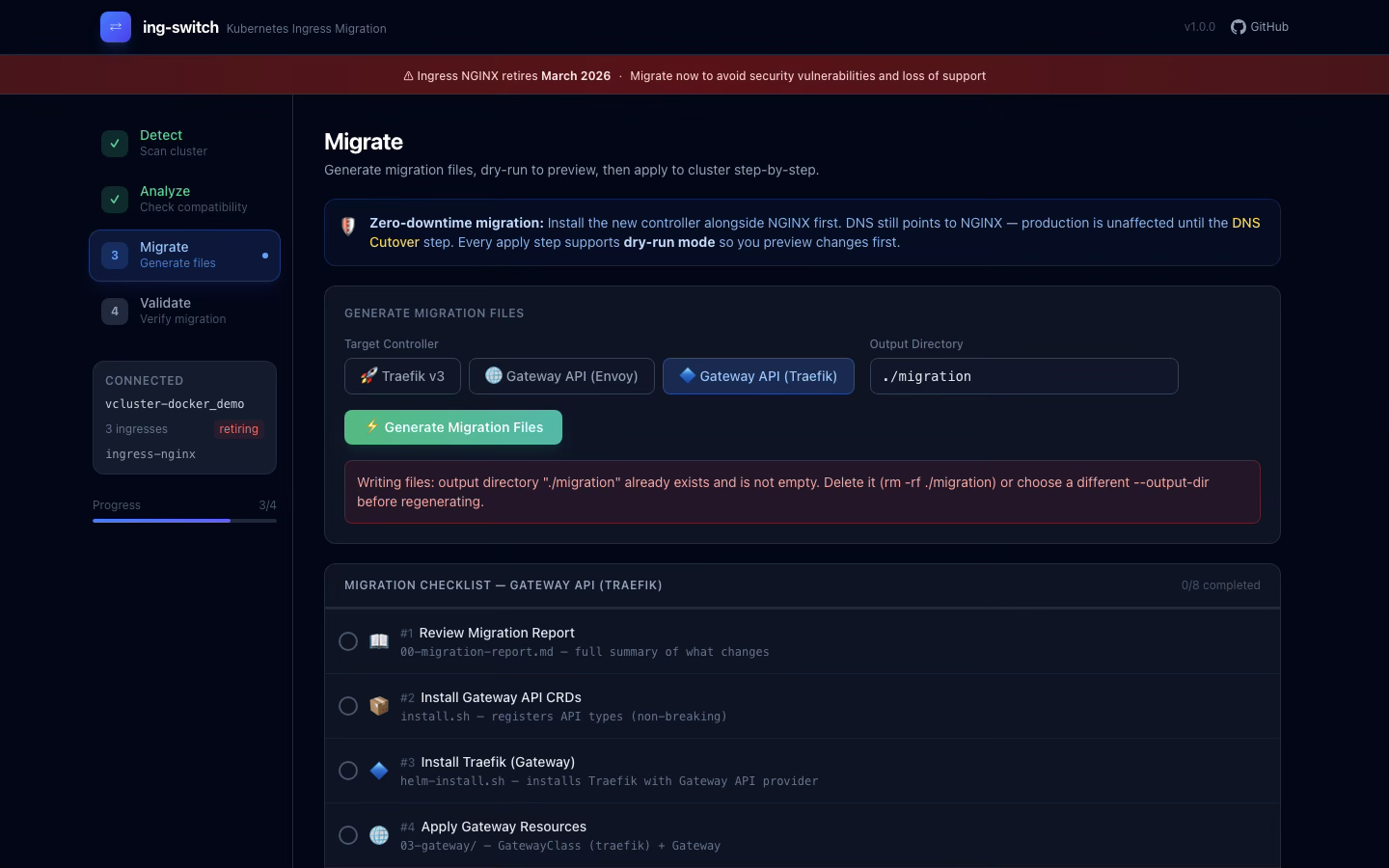
For teams that prefer a visual workflow:
ing-switch ui
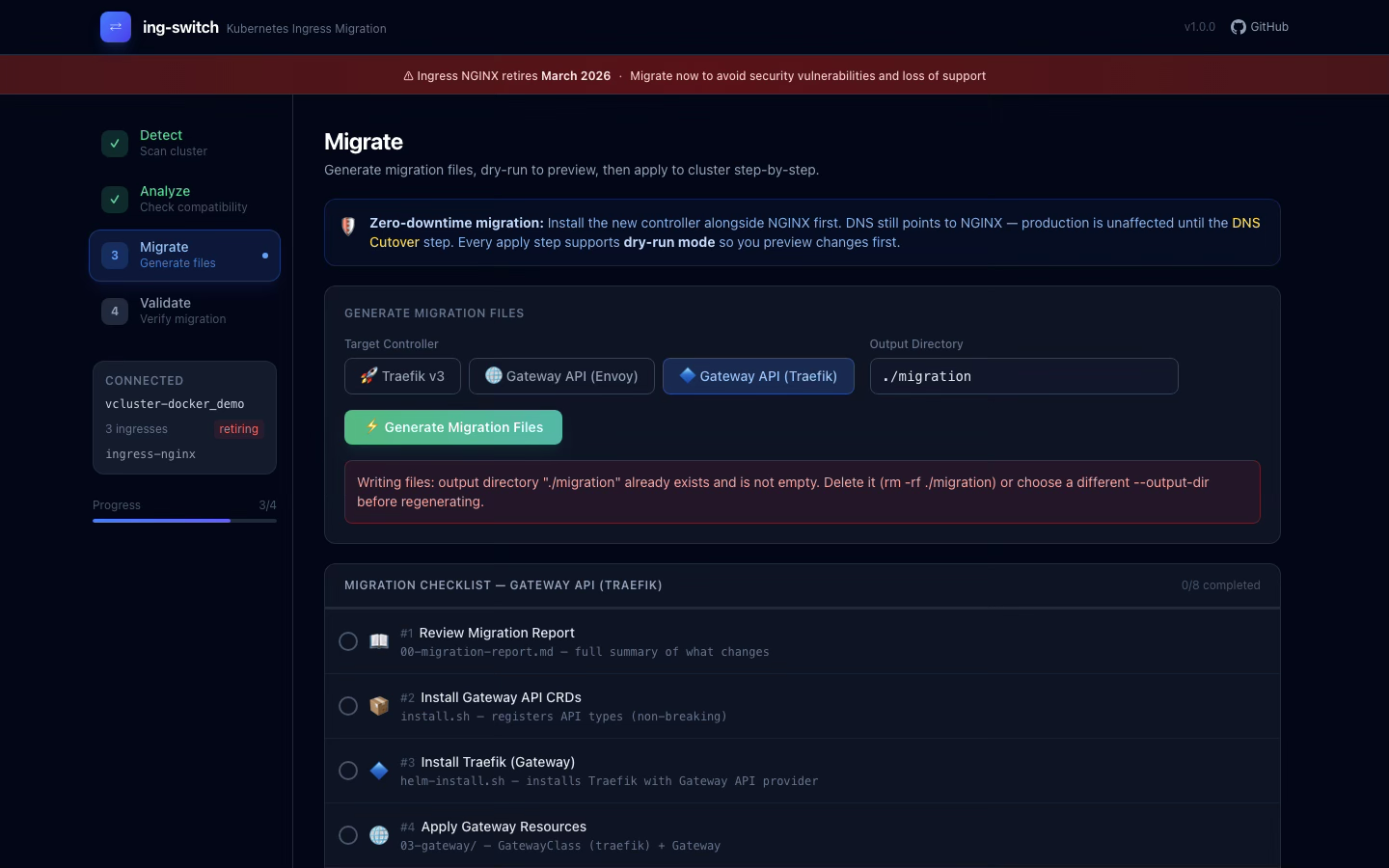
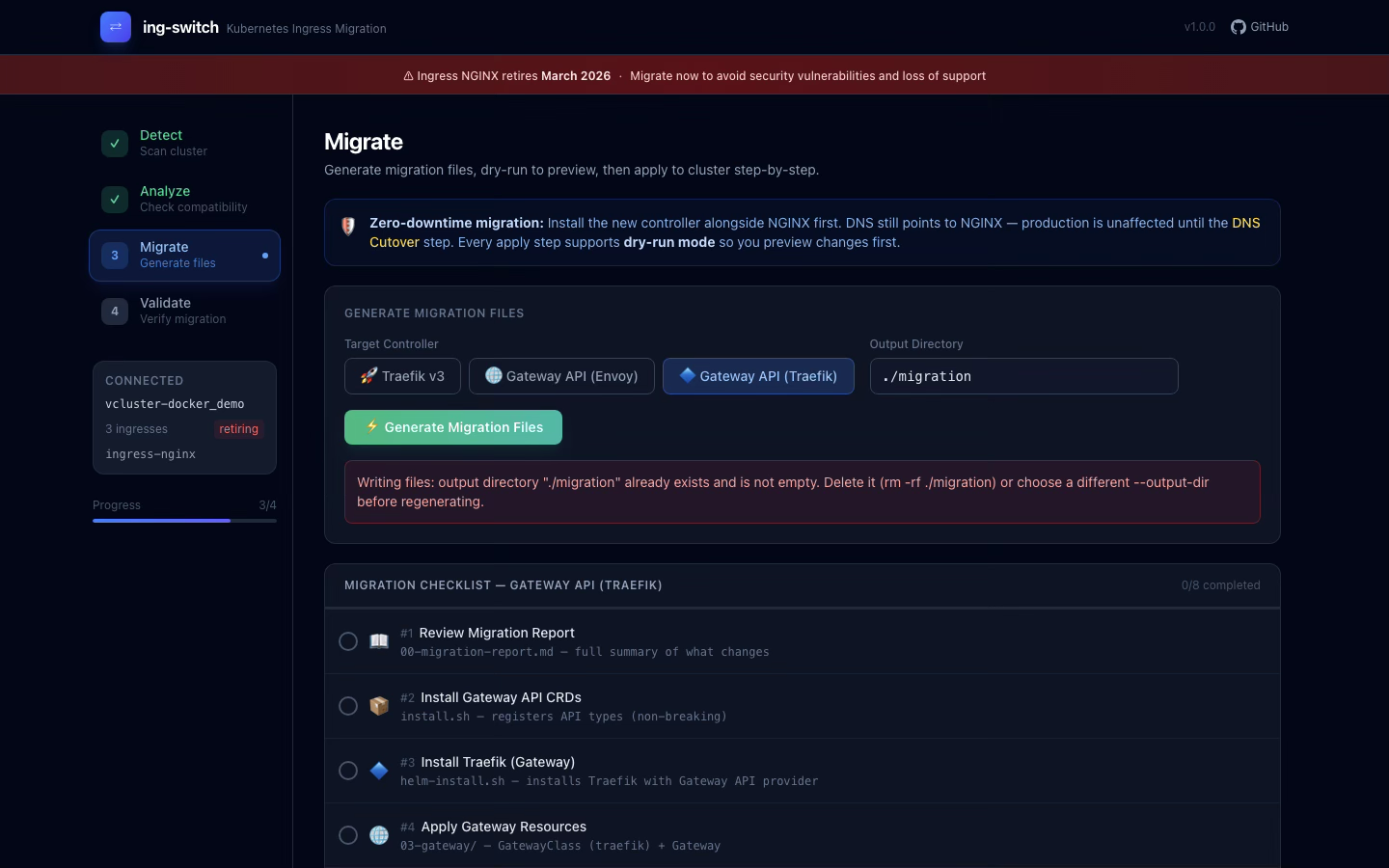
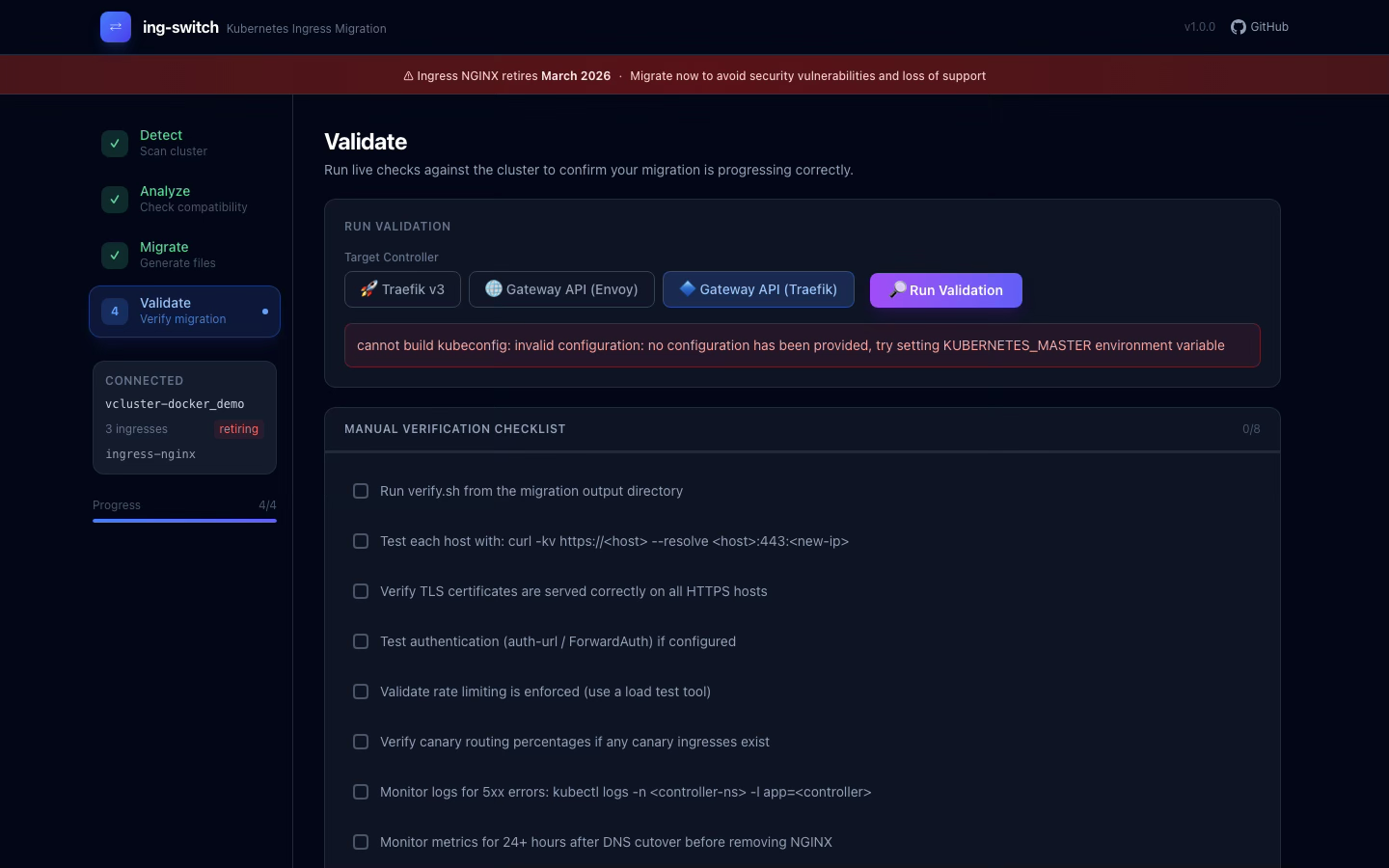
# Opens http://localhost:8080The dashboard provides four pages:
Detect -- Scan your cluster and see all ingresses with annotation counts and complexity:
Analyze -- Choose between 3 targets and see the full annotation compatibility matrix:
Migrate -- One-click generation with step-by-step checklist and dry-run buttons:
View all generated files inline with syntax highlighting:
See migration gaps with impact ratings and fix instructions:
Validate -- Run live cluster checks to confirm your migration phase:
Cleanup #
vcluster delete demo --driver dockerdone Successfully deleted virtual cluster demoWhat Makes ing-switch Different #
| Feature | ing-switch | ingress2gateway | Manual |
|---|---|---|---|
| Annotation coverage | 119 | 30+ | You count |
| Traefik Ingress target | Yes | No | -- |
| Gateway API (Traefik) | Yes | No | -- |
| Gateway API (Envoy) | Yes | Yes | -- |
| Impact ratings | Yes | No | No |
| Web UI | Yes | No | No |
| Install scripts | Yes | No | No |
| Verification scripts | Yes | No | No |
| DNS migration guide | Yes | No | No |
| Dry-run mode | Yes | No | -- |
The Ecosystem Is Ready #
-
Gateway API v1.5 -- CORS filter, TLSRoute, BackendTLSPolicy all GA
-
ingress2gateway v1.0 -- Official tool with emitter architecture
-
Traefik v3.7 -- Native NGINX annotation provider (80+ annotations)
-
Envoy Gateway v1.7 -- XListenerSet, enhanced policies
-
cert-manager v1.20 -- Gateway API ListenerSet support
-
Kubernetes 1.36 -- Ships April 22, first release post-NGINX archival
The tools exist. The standards are stable. The only thing left is to actually run the migration.
Star it, fork it, migrate today: github.com/saiyam1814/ing-switch
ing-switch is open source under the MIT license. PRs welcome.
Saiyam is working as Head of DevRel at vCluster Labs. He is the founder of Kubesimplify, focusing on simplifying cloud-native & AI infrastructure. He is KubeCon Co-chair and has worked on many facets of Kubernetes, including machine learning platforms, scaling, multi-cloud, & managed Kubernetes services. When not coding, Saiyam contributes to the community by writing blogs and organizing local meetups for Kubernetes and CNCF. He is also a CNCF TAG OpsRes Chair & can be reached on Twitter @saiyampathak.
Get new posts in your inbox.
Spotted a typo or want to improve this post? Edit on GitHub →